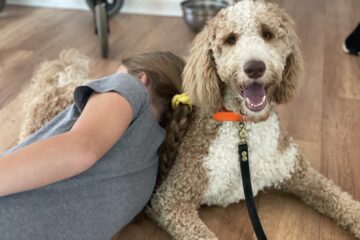
Children suffering from Autism Spectrum Disorders is a rapidly growing epidemic. This, often severe, developmental disorder affects the way that these children perceive the world around them as well as how they respond and interact with it. Autism Spectrum Disorders and Autism often cause decreased social interactions, the inability to verbalize thoughts and feelings, night terrors, self-stimulating behaviors and a broad range of other symptoms. This disorder not only affects the child diagnosed with it, but often affects, and can even cripple, the entire family of an autistic child. Families of autistic children often do not have resources readily available for managing some of the adverse affects this disorder causes.
One of the newest resources for assisting these families are Autism Assistance Dogs. These service dogs come in a variety of sizes and breeds and are specifically matched to meet the needs of the individual child. While out in public working with the dogs that we have in training, I am often asked “So, what do Autism Assistance Dogs do?” My answer is very often the same. These well trained dogs have a vast number of benefits for families and children suffering with autism.
First of all, these dogs serve as a “social bridge” for autistic children. Often, because of their behavior, these children are excluded from social settings by other children. Because a good number of children are automatically drawn to dogs, these social encounters are often increased and longer lasting. These dogs often accompany their children to school where they participate in the classroom with reading and recreational programs. This often helps to nurture increased participation in school activities with both classmates and the autistic child.
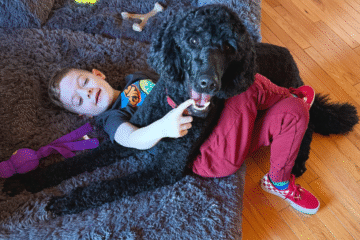
Autistic children also commonly exhibit self stimulating behaviors, also referred to as “stimming”. These repetitive behaviors include spinning, shouting, and hitting to name a few. Assistance dogs are often trained to disrupt these stimming behaviors by touching the child on the hand or leg. By doing this, the dog is able to redirect the focus of the child and break the cycle of the behavior.
Sleeping and night terrors are also common problems associated with Autism Spectrum Disorders. These dogs also assist with sleeping and creating better sleep habits with these children. Many Autistic children are very tactile and often sleep better when they experience some type of pressure and warmth at bed time. This often leads them to sleeping in bed with their parents for years, which can be disruptive for the entire family. Recently we delivered an assistance dog to a family in Florida. The first night that we arrived, the seven-year-old child, accompanied by his dog, slept soundly in his own bed for the first time in over five years.
Trailing is another valuable skill that these dogs are trained for in order to assist families with autistic children. Many of these children bolt or run away from their homes and public places. After bolting these children are often drawn to bodies of water and the end result can be fatal. These dogs are capable of locating the child in a variety of environments and terrain. This ability to locate the child quickly greatly reduces the risk of serious harm. Therefore, the ability to recover these children quickly is a valuable asset to any family with an autistic child.
Other benefits of having an Autism Assistance Dog are countless. These dogs increase independence, often increase the child’s vocabulary, and provide an overall calming effect for the child in what they deem to be stressful situations. We have seen that these dogs reduce emotional agitation, help children focus and work harder in school, and give these children more of a sense of pride and purpose by working with a service dog.
This article was featured in the June 2010 Issue of the Baby Boomer News magazine.
For more information on our Autism Assistance Dogs please feel free to contact us at 866.200.2207 or email us at info@autismassistancedog.com


Choosing a dog to work with your autistic child can be a daunting experience. It is important to remember your child and the dog are going to be together 24/7 and they must be able to work together. Your child’s temperament as well as the dog’s temperament must compliment each other. It is important to choose a dog that your child likes and feels comfortable with. The dog should feel the same. Make sure you spend a lot of time with the dog you are considering and make sure the trainer is willing to work with you on this issue. Multiple visits are suggested. Like Therapy Dogs, these special Service Dogs must be able to pass certain criteria. Because some autistic children are rough with dogs the dog must be able to tolerate a restraining hug, a finger in his/her ear,a tail pull, or any other rough behavior the child may inflict.